
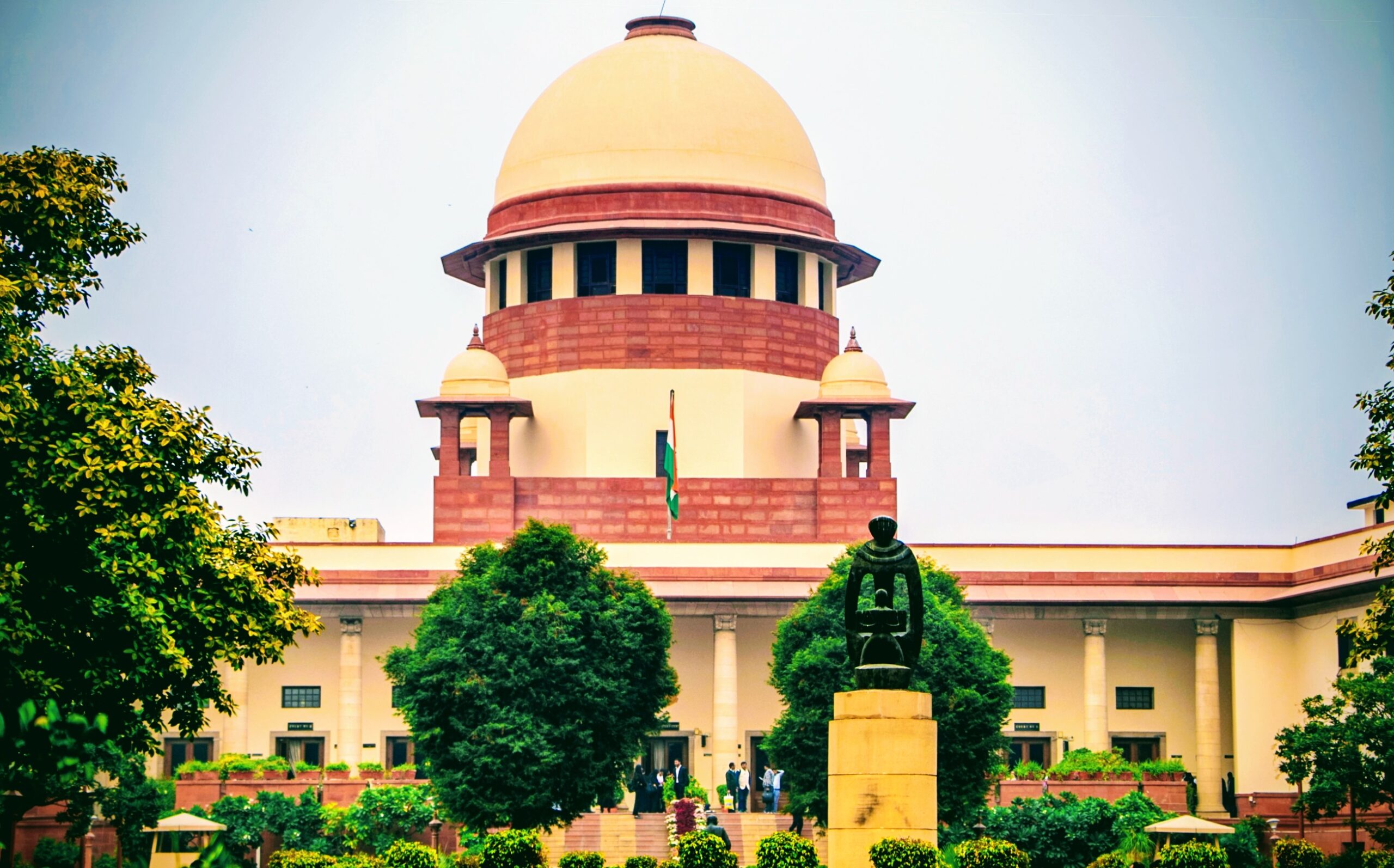
New Delhi, August 14 — The Supreme Court of India, while hearing an application seeking directions for the restoration of statehood to the Union Territory of Jammu & Kashmir, observed that the “ground realities” of the region cannot be ignored, citing incidents such as the recent Pahalgam terrorist attack.
A Bench comprising Chief Justice of India D.Y. Chandrachud, Justice B.R. Gavai, and Justice K. Vinod Chandran was hearing a Miscellaneous Application filed in the disposed of matter In Re: Article 370 of the Constitution, in which the apex court had upheld the abrogation of the erstwhile state’s special status.
Background of the Case
The application, filed by Senior Advocate Gopal Sankarnarayanan on behalf of college teacher Zahoor Ahmed Bhat, contends that despite the Union Government’s assurance during the Article 370 hearings that statehood would be restored “at the earliest,” no concrete steps have been taken in the last 21 months since the judgment.
The plea notes that the 2019 Jammu and Kashmir Reorganisation Act, which bifurcated the state into the Union Territories of J&K and Ladakh, was not examined for constitutionality in light of the Solicitor General’s assurance of eventual restoration of statehood (excluding Ladakh).
The judgment in the Article 370 case directed that:
- Legislative Assembly elections be conducted in J&K by 30 September 2024 under Section 14 of the Reorganisation Act.
- Restoration of statehood should occur “as soon as possible” after elections, but without any fixed timeline.
Petitioner’s Arguments
Advocate Sankarnarayanan stressed that the trust reposed by the Court in the Union’s assurance had not been honoured. He argued that the peaceful conduct of Assembly elections in J&K demonstrated there were no prevailing security threats or disturbances that could justify further delay in restoring statehood.
The applicants — Zahoor Ahmed Bhat and activist Khurshaid Ahmad Malik — maintain that non-restoration violates the basic structure of the Constitution, particularly the principle of federalism.
Union Government’s Stand
Appearing for the Centre, Solicitor General Tushar Mehta opposed the application, stating that it was not maintainable and recalling that similar pleas had earlier attracted costs from the Court. The SG submitted that the situation in J&K involves “peculiar considerations” and that election-related decisions involve multiple factors.
Court’s Oral Observations
During the hearing, the Chief Justice noted that the restoration of statehood must be considered alongside security realities, remarking:
“You also have to take into consideration the ground realities; you cannot ignore what has happened in Pahalgam.”
Counsel for other applicants, including Senior Advocate Menaka Guruswamy (representing applicant Irfan Lone), urged that a dedicated Bench be constituted to hear all related petitions together.
Next Steps
The Supreme Court has listed the matter for hearing after eight weeks and directed the Union Government to file its response before the next date.
Case Details
- Title: Zahoor Ahmad Bhat & Anr. vs Union of India
- Case No.: MA 2259/2024 (with connected matters)
- Filed by: Advocate-on-Record Soayib Qureshi
Keywords:
Restoration of Statehood to Jammu & Kashmir, Supreme Court Article 370, J&K Reorganisation Act 2019, Zahoor Ahmed Bhat Petition, Pahalgam Terrorist Attack, Federalism in India, UT of Jammu and Kashmir, Assembly Elections J&K 2024, CJI BR Gavai, Tushar Mehta
