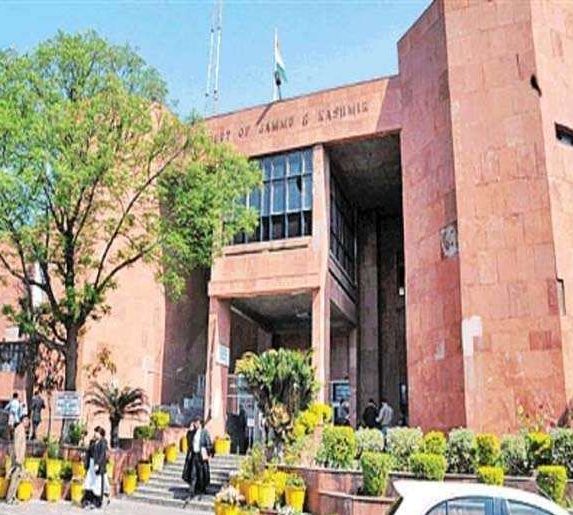
Operational Nexus Essential for Claiming War Injury Pension, Rules High Court
Shivaji Rathore, 21 - March- 2026
In a significant ruling, the High Court of Jammu & Kashmir and Ladakh has held that accidental injuries suffered by armed forces personnel cannot be classified as “war injuries” or “war casualties” unless there exists a clear and direct nexus between the injury and operational duties in a Government-notified operational area.
A Division Bench comprising Justice Sanjeev Kumar and Justice Sanjay Parihar emphasized that merely being posted in an operational area does not automatically entitle a personnel to claim war injury benefits. The Court underscored that the essential requirement is a direct and causal connection between the injury and operational duties.
The Bench observed:
“Accidental injuries or deaths which are not in any way connected with the operational duties cannot be said to be ‘War Casualties’ or ‘War Injuries’. There should be a direct and causal connection of the injury with the duties connected with the operational area specially notified by the Government.”
Background of the Case
The case arose from a petition filed by Raghbir Singh, a retired soldier of the Punjab Regiment, who challenged the denial of the “war injury element” of pension. He had instead been granted disability pension. The petitioner had been enrolled in the Indian Army in 1977 and, while serving with the 16 Punjab Regiment, sustained a gunshot injury to his left hip on 14 June 1990 at Rupa Post. The injury occurred due to negligent handling of a weapon by a fellow soldier. Following a Court of Inquiry, the injury was held attributable to military service in a field service concessional area. The petitioner was placed in a permanent low medical category and discharged in 1994 with disability pension, which was later continued for life. Over fifteen years later, after obtaining documents under the Right to Information Act in 2021, the petitioner sought reclassification of his injury as a “war injury” to claim enhanced pensionary benefits. His claim was rejected by the authorities and subsequently by the Armed Forces Tribunal, leading him to approach the High Court.
Court’s Analysis
The High Court undertook a detailed examination of the legal framework governing “battle casualties” and “war injuries,” including the relevant Special Army Orders and the Ministry of Defence policy dated 31 January 2001. Referring to the provisions governing battle casualties, the Court noted that such classification applies primarily to injuries sustained: In action against enemy forces, While repelling enemy attacks, During operational engagements in notified areas.
While the petitioner relied on a clause suggesting that accidental injuries in operational areas could be treated as battle casualties, the Court clarified that the injury must still occur “in action.”
In the present case, the injury was caused by negligent handling of a weapon by a fellow soldier and had no connection with any operational activity or engagement with the enemy. Even assuming that the location fell within an operational area under Operation Rakshak, the Court held that the absence of any operational nexus was fatal to the claim.
On Ministry of Defence Policy (2001) The Court also examined the Ministry of Defence letter dated 31 January 2001, which categorizes disabilities and deaths for pensionary benefits.
It noted that Category E covers injuries arising from: Enemy action, War-like situations, Border skirmishes, Notified operations.
However, the Bench reiterated that even under this policy, a direct link between the injury and operational activity is mandatory. Additionally, the Court pointed out that the policy applies to personnel in service on or after 1 January 1996, whereas the petitioner’s injury occurred in 1990. Therefore, the policy was not applicable to his case.
Conclusion
Finding no infirmity in the decision of the Armed Forces Tribunal, the High Court dismissed the petition and upheld the rejection of the claim for the war injury element of pension.
The ruling reinforces a crucial legal distinction: not all service-related injuries qualify as war injuries. Only those injuries that are directly connected with operational duties in notified areas can be classified as such, ensuring that the enhanced pensionary benefits are reserved for genuinely operational casualties.
Case Title: Raghbir Singh v. Union of India & Ors.
WPC 191/2024