1. Presumption of innocence
In the Indian criminal justice system, a fundamental premise is that every accused is presumed innocent until proven guilty. This principle places the burden of proof entirely on the prosecution. Unless the prosecution can establish guilt beyond reasonable doubt through credible evidence, the court cannot convict the accused. This foundational safeguard ensures that no individual is punished without lawful justification.
- When in Doubt, Favour the Accused
Another cornerstone of criminal law interpretation is that any ambiguity in the evidence must be resolved in favour of the accused. If the material on record supports two possible views—one pointing to guilt and the other to innocence—the benefit of doubt must go to the accused. This approach aligns with the doctrine of fair trial and ensures protection against wrongful conviction.
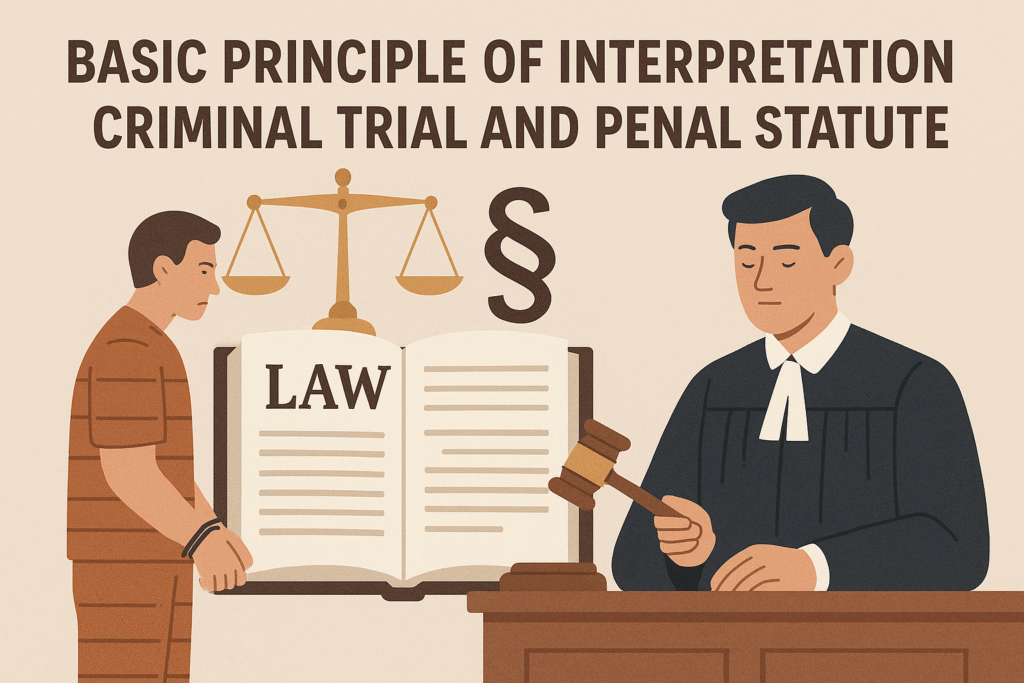
- Interpretation of Penal Statutes: Strict and Favourable
Penal statutes must be interpreted strictly, without expanding their scope through judicial innovation. However, if a provision is open to two interpretations, the court is expected to prefer the one that benefits the accused. Courts are not permitted to dilute or soften the law’s effect unless the legislature clearly intends such an outcome.
- Judicial Precedent: A Guiding Light
In Pohalya Molya v. State of Maharashtra, the Supreme Court reiterated that where two constructions are possible, the interpretation that benefits the accused must prevail. This decision reflects the judiciary’s commitment to ensuring fairness in criminal trials by upholding protective interpretations.
- Ambiguity in Penal Law: Lean Towards Liberty
If a penal statute is unclear or ambiguous, the interpretation favouring the accused must be accepted. This is a time-honoured principle aimed at safeguarding individual liberty, especially in a system where liberty is a cherished constitutional value.
- Role of Section 358 BNSS: Not to Be Misused
The power under Section 358 of the Bharatiya Nagarik Suraksha Sanhita (BNSS) cannot be invoked merely because some evidence implicates a person. The overall context and intent of the case must guide such decisions, preventing misuse of procedural powers to harass individuals unjustly.
- Retrospective Application: Substantive vs. Procedural Law
Laws dealing with substantive rights cannot be applied retrospectively unless explicitly stated by the legislature. However, procedural laws may operate retrospectively, provided they do not affect the core rights of the accused. The law prevailing at the time of the alleged offence remains applicable unless duly amended.
- Understanding Legislative Intent
Courts are tasked with interpreting statutes in a way that aligns with the purpose and objective behind the law. While plain language is usually followed, courts may, in appropriate cases, deviate from literal interpretation to ensure justice. However, they must not stretch or modify the language of a statute to suit a presumed intention.
- Constitutional Interpretation: Preserving Validity
Statutes should be interpreted liberally to uphold their constitutionality. When faced with two interpretations, the one that maintains the law’s alignment with constitutional principles should be preferred to avoid invalidation.
- Right to Fair Trial: Beyond the Written Word
The Rajasthan High Court has emphasized that fair trial includes adherence to principles of natural justice, such as audi alteram partem (hear the other side). Even if procedural laws do not explicitly require sharing all collected evidence, such a right must be inferred to uphold the right to an effective defence under Article 21 of the Constitution.
Denying access to favorable evidence or presenting only partial information undermines fair trial standards and creates an illusion of justice—what the court termed as a “kangaroo court.” Such practices violate both Article 14 and Article 21, which guarantee equality before law and protection of life and liberty.
- Role of Prosecution and Investigation: Duty of Fairness
The prosecution and investigating agencies represent the State and are expected to act in a manner that is fair, just, and reasonable. Withholding exculpatory evidence without valid legal reason violates constitutional guarantees and undermines public trust in the justice system. Justice demands full transparency and honesty in court proceedings.
- Clean Hands Doctrine: Truth Before the Court
Every party appearing before a court is expected to do so with clean hands. The prosecution must disclose all relevant facts, including those that support the accused. Concealing vital evidence not only violates the ethical duties of the prosecution but also obstructs the court from reaching a just decision.
Conclusion: Liberty is the Rule, Not the Exception
The interpretation of criminal laws must always tilt in favour of liberty, fairness, and justice. Courts must balance legislative intent with constitutional principles, ensuring that the accused is never punished without full due process. Protecting the rights of the accused is not merely a legal formality—it is the cornerstone of a just society.
For More updates stay tuned with TACIT LEGAL