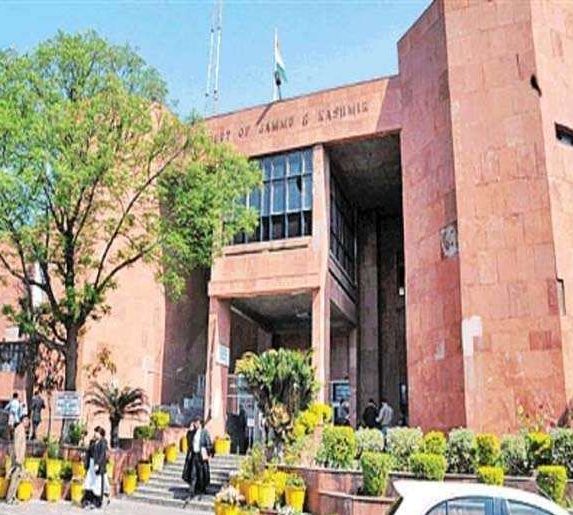
Chief secretary directed to Frame SOP’S
Jammu & Kashmir High Court on Continuing Liability of the State in Contractor Payment Dispute
Case: M/s Saint Soldier Engineer and Contractor Pvt. Ltd. v. UT of J&K & Ors.
Court: High Court of Jammu & Kashmir and Ladakh, Jammu
Coram: Hon’ble Justice Wasim Sadiq Nargal
For Petitioners:- Mr. Gagan Kohli, Advocate
Mr. Manik Bhardwaj, Advocate
Date of Judgment: 26.09.2025
The High Court of Jammu & Kashmir and Ladakh, in a significant ruling on 26 September 2025, reaffirmed that the State carries a continuing liability to pay contractors for work duly executed and cannot evade its obligations on hyper-technical pleas such as limitation or paucity of funds. The Court directed the release of ₹97.87 lakhs along with 6% interest, stressing that withholding admitted dues amounts to arbitrariness, violates Articles 14, 21, and 300A of the Constitution, and that officers responsible for such delays may face personal accountability
Background
The petitioner, a registered government contractor, executed road construction work under E-NIT No. CD-1/63 of 2014-15. Initially valued at ₹50.33 lakhs, the scope of work was later revised to include laying of Bitumen Macadam and premix carpet, enhancing the contract value to ₹23.73 crores. The contractor successfully completed the project in 2017. While part payment was released, an amount of ₹97,87,012/- remained pending despite final bills being prepared and liability admitted by the Public Works Department (PWD). Multiple representations were made, but the payment was withheld on the plea of paucity of funds. Aggrieved, the contractor approached the High Court seeking release of dues with interest.
Court’s Observations on Continuing Liability
The Court emphasized that the matter was not a stale or time-barred claim, but one concerning continuing liability of the State.
Quoting directly from the judgment:
“Rather, it concerns a continuing liability of the State which stands acknowledged on more than one occasion. For facility of reference, Sections 18 of the Limitation Act is reproduced as under:-
Section 18 of the Limitation Act
“18. Effect of acknowledgment in writing.—(1) Where, before the expiration of the prescribed period for a suit or application in respect of any property or right, an acknowledgment of liability in respect of such property or right has been made in writing signed by the party against whom such property or right is claimed, or by any person through whom he derives his title or liability, a fresh period of limitation shall be computed from the time when the acknowledgment was so signed.
(2) Where the writing containing the acknowledgment is undated, oral evidence may be given of the time when it was signed; but subject to the provisions of the Indian Evidence Act, 1872 (1 of 1872), oral evidence of its contents shall not be received.
Explanation.— For the purposes of this section,—
(a) an acknowledgment may be sufficient though it omits to specify the exact nature of the property or right, or avers that the time for payment, delivery, performance or enjoyment has not yet come or is accompanied by a refusal to pay, deliver, perform or permit to enjoy, or is coupled with a claim to set off, or is addressed to a person other than a person entitled to the property or right,
(b) the word “signed” means signed either personally or by an agent duly authorised in this behalf, and
(c) an application for the execution of a decree or order shall not be deemed to be an application in respect of any property or right.”
Key Findings of the Court
Acknowledgment of Liability:
“It is not disputed that the respondents themselves acknowledged the liability in the year 2018, which was well within the period of limitation, and the same was again reaffirmed in 2020. Once liability is admitted and the State continues to enjoy the fruits of the work executed by the petitioner, it cannot be permitted to turn around and deny payment on the plea of limitation.”
Recurring Liability:
“The liability in the present case is in the nature of a recurring liability. The work has been executed, utilized, and the benefits continue to accrue to the respondents. In such cases, the cause of action is a continuing one, and every day of non-payment constitutes a fresh infraction of the petitioner’s rights. Therefore, the bar of limitation cannot be rigidly applied to defeat such claims.”
Discretion under Article 226:
“It is equally well settled that the power under Article 226 of the Constitution is discretionary in nature. While it is true that ordinarily claims which are stale, delayed, or barred may not be entertained, the Court retains discretion to intervene where arbitrariness, admitted liability, or unjust enrichment of the State is writ large.”
Rejection of State’s plea of limitation:
“Thus, the argument of Mr. Ravinder Gupta learned AAG that the writ petition is time barred merely because the petitioner did not agitate his cause earlier cannot be accepted. The duty of the State to pay for work executed and enjoyed is a constitutional obligation flowing from Article 14, and delay in seeking enforcement of such right cannot absolve the State from its responsibility.”
Reliance on Precedents
The Court relied upon Union Territory of J&K & Ors. v. Mohammad Atzal Reshi (2024), where it was held that keeping contractors waiting for years under the pretext of “paucity of funds” is “abominable and condemnable”, especially when the Government claims to be part of one of the world’s largest economies but fails to pay even small amounts of admitted dues.
The Court also invoked Article 300A of the Constitution: “No person shall be deprived of his property save by authority of law.”
Citing K.T. Plantation Pvt. Ltd. v. State of Karnataka (2011) 9 SCC 1, it was reiterated that property rights include monetary dues, and the State cannot unjustly retain contractors’ money without lawful authority.
The Court also cited Union of India v. Raman Iron Foundry (1962) 3 SCR 556, affirming that delayed payments attract interest as compensation for financial hardship.
Further reliance was placed on:
Ramakrishna Construction Co. v. Union of India (2010) 3 SCC 579 – once liability is admitted, payment cannot be arbitrarily withheld.
Surya Constructions v. State of U.P. (1986) 3 SCC 247 – writ jurisdiction can be invoked when admitted dues are withheld without justification.
Legal principles and directions laid down
The Court issued strong directions to ensure fairness in contractual payments:
A. Obligation to Pay Post Completion: Once the work is executed as per contract, the State is under a clear obligation to release dues without arbitrary delay.
B. Rejection of Post-facto Objections: Administrative approvals or diversion of funds cannot be grounds to withhold payment after work is completed.
C. Interest on Delayed Payments: Contractors are entitled to interest at prevailing bank rates from the date payment fell due until actual release.
D. Personal Accountability of Officers: Where withholding of payments arises from negligence or mala fide conduct, interest liability shall be recovered from the salaries of responsible officers.
E. Constitutional & Welfare Considerations: A welfare State cannot plead paucity of funds to deny payments. In cases of habitual withholding, exemplary costs may be imposed on the erring department, payable to the State Legal Services Authority.
Chief Secretary’s SOP Direction: The Chief Secretary of J&K was directed to frame a Standard Operating Procedure (SOP) ensuring no admitted dues remain unpaid beyond 60 days from submission of final bills (where no legal impediment exists).
Final Order
The High Court directed the respondents to release the outstanding ₹97,87,012/- within four weeks, along with 6% interest from 2017 until actual payment. The judgment reaffirms that the State cannot evade its financial obligations, and that continuing liability ensures contractors are not denied their rightful dues under hyper-technical pleas of limitation.
This judgment is a landmark ruling strengthening the rights of contractors by ensuring timely payments, accountability of officers, and recognition of continuing liability of the State
Read our other articles on different courts judgments visit our home page
This article cover the order/judgments on continuing liability of state of Jammu kashmir in contract cases where writ petition was filed for not giving him payment for work done hence it was settled by the Hon’ble high court of Jammu and Kashmir and ladakh at Jammu bench where some principles was also laid down for the benifit of contractors and Chief secretary of Jammu kashmir union territory was directed to prepare SOP’s for the same . further you can read here important judgements and legal principles laid down by Hon’ble supreme court of India, this article is posted by Advocate Shivaji Rathore (J&K high court jammu) for more important legal topics stay connected with us, on tacit legal we post on YouTube channel also named as Tacit Legal helpful for Law students newely enrolled Advocate in India and other states, Follow us on Instagram also, Read our articles on important Questions of Law. #tacitlegal visit my website Tacit Legal dot in search on google, this website is made from Hostinger and wordpress follow our latest updates for legal news follow us on YouTube also for young lawyers law students helpful for Advocates, this blog is written by Advocate Shivaji Rathore practicing in Jammu and Kashmir high court and district court at Jammu. The website Tacit Legal is available on Google created with Hostinger and wordpress keep in touch and read our daily articles and reporting for law students and advocates as we provide you important legal information on Tacit Legal.in