
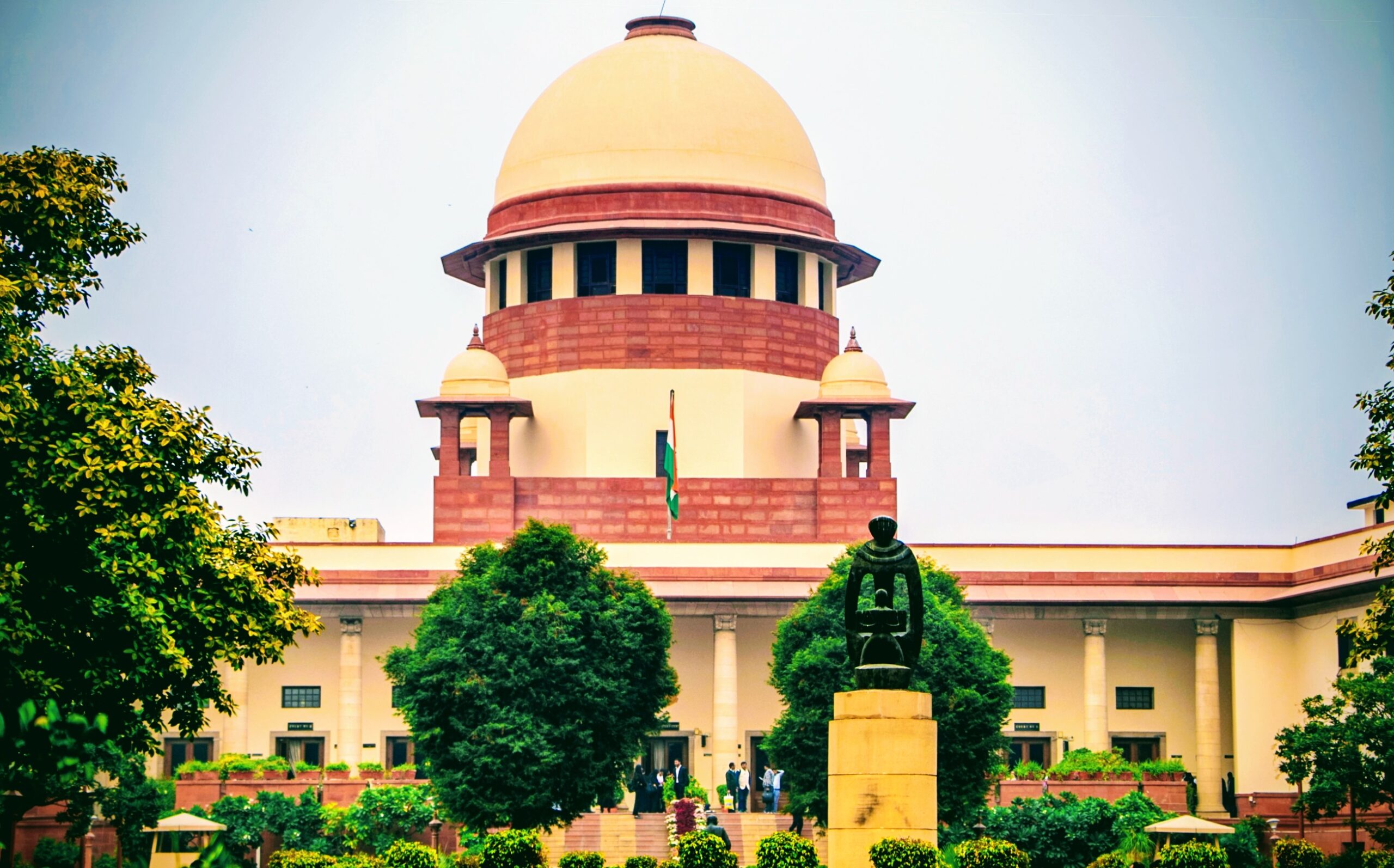
Date of Judgment: July 14, 2025
Case Title: Estate Officer, Haryana Urban Development Authority & Ors. vs. Nirmala Devi
(CIVIL APPEAL NO. 7707 OF 2025 (Arising out of Special Leave Petition (C) No. 15148 of 2017)
The Supreme Court of India has reiterated that a mandatory injunction under Section 39 of the Specific Relief Act, 1963 (SRA) is a discretionary and exceptional remedy, which can only be granted upon the breach of a clearly enforceable legal obligation.
Delivering the judgment, Justice J.B. Pardiwala & Justice R. Mahadevan emphasised that before granting such relief, the court must be satisfied that the plaintiff has established a binding legal duty, proved a breach of that duty, and shown that compelling the defendant to perform specific acts is both necessary and enforceable.
What is a Mandatory Injunction under Section 39 SRA?
Section 39 of the Specific Relief Act empowers courts to issue mandatory injunctions—orders compelling a party to perform a certain act—to enforce an obligation and prevent further harm. Unlike prohibitory injunctions, which restrain actions, mandatory injunctions require positive action.
The Supreme Court clarified that this form of injunction is not a matter of right but a matter of judicial discretion, exercised only in exceptional circumstances.Court’s Observations in the Present Case
The Court held that:
A mandatory injunction cannot be granted unless there exists a legal right and there is a breach of that legal right.
The plaintiff must prove with pleadings and evidence that the defendant is breaching a binding obligation.
There must be acts capable of being specifically enforced in view of the terms of the policy or contract.
Bench observed :-
“The breach of obligation and the compulsion to perform certain acts in relation to such obligation must be specifically established before a mandatory injunction can be granted.”
The plaintiff must satisfy the court through proper pleadings and cogent evidence that the defendant is committing a breach of a binding obligation.”
Conditions for Granting a Mandatory Injunction
The Supreme Court summarised the established legal principles for granting a mandatory injunction as follows:
1. Clear Obligation: There must be a well-defined obligation binding on the defendant.
2. Breach of Obligation: A breach must have occurred or be reasonably apprehended.
3. Necessity: It must be necessary to compel specific performance to prevent or remedy the breach.
4. Enforceability: The act required must be capable of being enforced by the court.
5. Balance of Convenience: The balance of convenience must favour the plaintiff.
6. Irreparable Injury: The harm caused by the breach must be irreparable or not adequately compensable through monetary damages.
Significance of the Judgment
This decision reinforces that mandatory injunctions are not to be granted lightly. They are a powerful equitable remedy meant to be used sparingly, ensuring that the legal rights of the plaintiff are fully protected without unduly burdening the defendant.
For litigants, this judgment serves as a reminder that to succeed in a suit for a mandatory injunction, one must:
Prove the existence of a binding legal obligation.
Show an actual or imminent breach.
Demonstrate that monetary compensation is inadequate.
Date of Judgment: July 14, 2025
Case Title: Estate Officer, Haryana Urban Development Authority & Ors. vs. Nirmala Devi
(CIVIL APPEAL NO. 7707 OF 2025 (Arising out of Special Leave Petition (C) No. 15148 of 2017
Keywords:-
Mandatory Injunction, Section 39 Specific Relief Act, Supreme Court Judgment, Breach of Legal Obligation, Indian Contract Law, Justice Pardiwala, HUDA vs Nirmala Devi, Discretionary Remedy, Indian Civil Law, Injunction Cases in India.



My husband and i ended up being really joyful that Edward managed to finish off his investigation via the precious recommendations he had out of the web pages. It’s not at all simplistic to just find yourself making a gift of tactics which other people might have been trying to sell. And we figure out we have the writer to be grateful to because of that. The entire illustrations you’ve made, the simple website navigation, the relationships you will help promote – it is everything amazing, and it’s really letting our son and the family imagine that that topic is thrilling, and that’s exceedingly vital. Thanks for everything!