Check bounce case No Jail after settlement between parties
Case Details
Gian Chand Garg v. Harpal Singh & Anr.
Criminal Appeal of 2025 (Arising out of SLP (Crl.) No. 8050 of 2025)
Court:
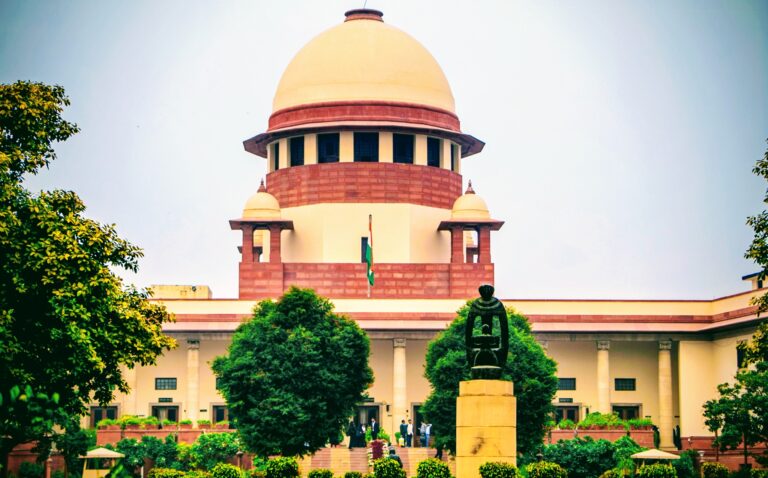
Supreme Court of India Criminal Appellate Jurisdiction
Bench:
Justice Aravind Kumar and Justice Sandeep Mehta
Date of Judgment:
11 August 2025
Background of the Case
The present appeal arose from a judgment of the Punjab and Haryana High Court which had affirmed the conviction of the appellant under Section 138 of the Negotiable Instruments Act, 1881 (NI Act).
The complainant alleged that the appellant had borrowed a sum of ₹5,00,000 and issued a cheque towards repayment. On presentation, the cheque was dishonoured with the endorsement “funds insufficient.” Despite issuance of a statutory notice, the payment was not made, leading to prosecution under Section 138 NI Act.
The Trial Court convicted the appellant and sentenced him to six months’ simple imprisonment along with a fine of ₹1,000. The conviction was upheld by the Sessions Court as well as the High Court, prompting the present appeal before the Supreme Court.
Compromise Between Parties
After dismissal of the revision petition by the High Court, both parties entered into a settlement dated 06.04.2025, wherein the complainant accepted two demand drafts of ₹2.5 lakhs each and three cheques of ₹1 lakh each towards full and final settlement. The complainant further filed an affidavit indicating his no objection to the appellant’s acquittal.
Despite this, the High Court refused to modify its earlier order, terming the application as non-maintainable.
Supreme Court’s Observations
The Supreme Court (SCO) noted:
The offence under Section 138 NI Act is essentially a civil wrong, though clothed with criminal consequences to maintain the credibility of commercial transactions.
Section 147 of the NI Act, introduced by the 2002 amendment, expressly makes the offence compoundable at any stage of proceedings.
Referring to precedents such as Meters and Instruments Pvt. Ltd. v. Kanchan Mehta (2018), P. Mohanraj v. Shah Brothers Ispat Pvt. Ltd. (2021), and Gimpex Pvt. Ltd. v. Manoj Goel (2021), the Court reiterated that once parties have voluntarily settled the dispute, the conviction cannot be sustained.
The Court emphasized that the compromise deed and affidavit filed by the complainant clearly established voluntary settlement without coercion. Thus, continuation of criminal proceedings would serve no legal purpose.
Judgment
Allowing the appeal, the Supreme Court set aside the concurrent findings of conviction and sentence imposed by the courts below. The conviction of the appellant under Section 138 NI Act was quashed in view of the settlement.
Key Takeaways
1. Cheque bounce cases under Section 138 NI Act are compoundable at any stage due to Section 147.
2. Voluntary settlements between parties must be respected by courts to reduce unnecessary litigation.
3. The Supreme Court reaffirmed that dishonour of cheques, though having criminal consequences, is primarily a civil dispute in criminal clothings.
Also read my other articles landmark-ruling-supreme-court-upholds-right-to-motorable-highways